Thursday, 17 May 2018

Our Northern Tour – Part Two


We were woken at 4am on Thursday, May 10th, at Evstratios by the arrival of the Hellenic Seaways ferry, as promised by the port police. We went back to sleep and got up early to leave for Myrina, Limnos at 7. We had a speedy motor-sail in a Force 3 southeasterly and arrived at Myrina, having covered 21 miles, at 9.50. We went stern-to the quay in Myrina, where there were already four yachts,

including Paddy and Sally on Skylark, who had gone from Mytilene to Ayvalik, to check out of Turkey, then back to Lesbos before crossing to Myrina the day before.
Myrina is a very attractive, very Greek, quite large and apparently prosperous town, with a big castle up on the hill, big beaches and narrow winding streets. It even has municipally-owned Boris bikes, though the bikes had not yet been installed.


We walked up narrow lanes, over the hill, 

to look for a laundry, stopped at the promenade on the northern side of the town,

then went shopping, before having an excellent lunch of grilled sardines and baked feta at a taverna in the little fishing boat harbor.  

During the afternoon more yachts came in – the Russian skippered charter we had been alongside in Plomari; Miguel, a Spanish fisherman in a Dutch registered yacht who had been with us in Agios Evstratos; and later a huge new Bulgarian Moody 54DS. Sally and Paddy came for a drink before we had dinner aboard and an early night.
Friday, May 11th, was a grey day with more wind from the north and spots of rain. After breakfast we walked up to the enormous castle on a large rock outcrop, which divides the town in two. 

The castle was originally Byzantine, started in 1186, and probably built on the site of the ancient acropolis. It was then expanded by the Venetians and later by the Ottomans.  It was damaged when it was besieged by the Russians in 1770 and occupied by the Germans in the Second World War, when it was bombed, but it is still very well preserved, with very good information panels and fantastic views of the town and surroundings (and across to Athos when the visibility is good).  On the way up we met some of the little wild deer who live here, and we met more inside the castle. 

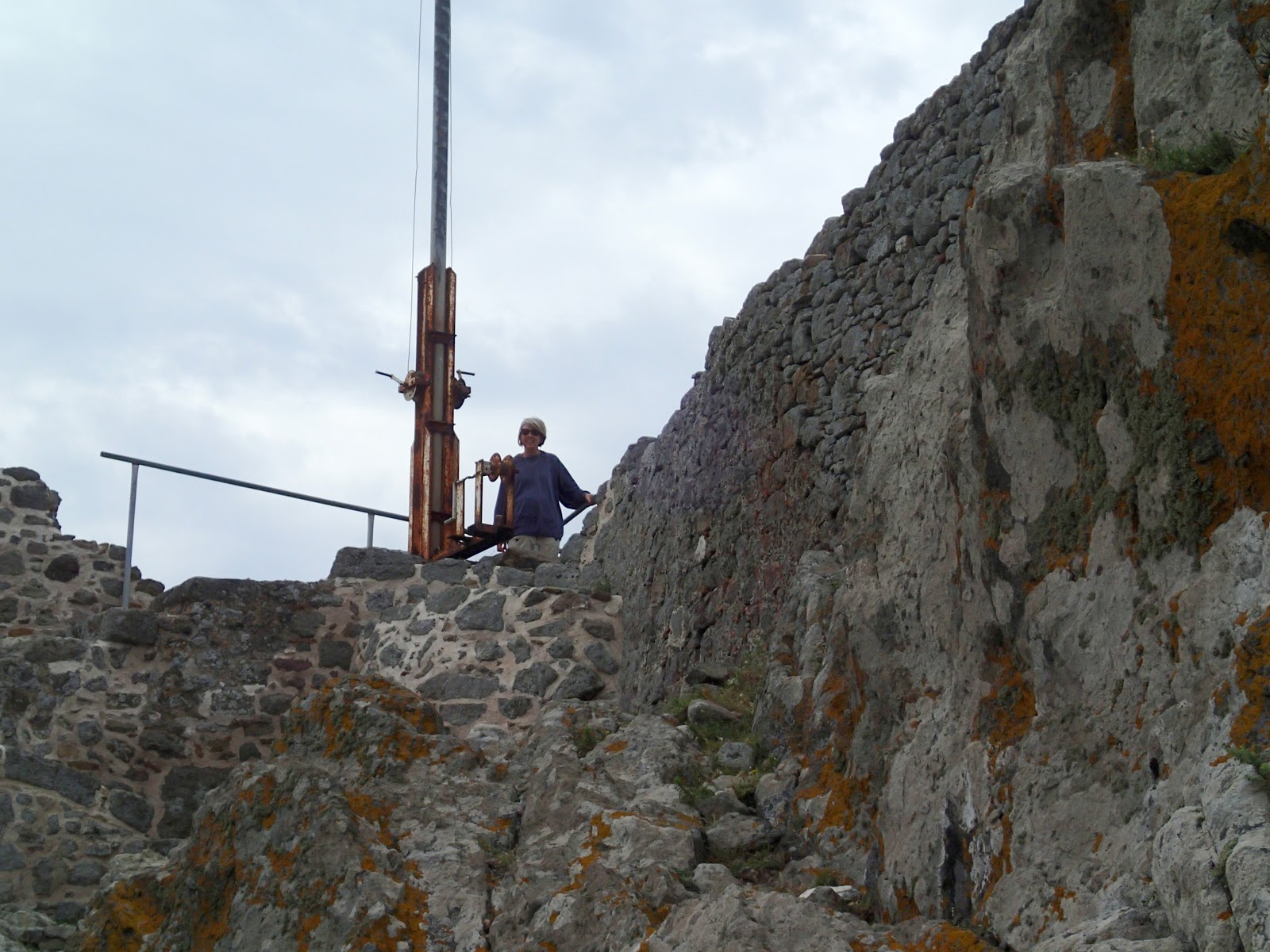
We walked all the way around the castle and up to the top,
The entrance


The Mosque

The barracks

The top of the inner castle


taking in the views.


We came down from the castle, collected our laundry, went shopping and pottered around until lunch. After lunch we walked all-round the bay on the north side of town. The Archaelogical Museum was closed for restoration, but we visited the very interesting site of prehistoric Myrina, with the remains of houses dating back to the beginning of the third millennium BC, together with Polyochni, the oldest city in Europe. 

At its peak it is estimated to have had a population of 3,000. When we got back to the boat we did some odd jobs, had drinks with Paddy and Sally and had dinner aboard. By amazing coincidence Paddy had been at school with Lin’s brother, John, though he is a few years younger, and Sally had run a lymphoma charity, so supporting Simon.
On Saturday, May 12th, we hired a car for the day and drove around the island. We went first to Moudhros, where we stopped at the East Moudhros military cemetery, mostly filled by those who died of wounds from Gallipoli, but also a group of White Russian refugees from the civil war. 

Moudhros Bay was where the ships supporting the Gallipoli campaign were based and to which the hospital ships brought back the wounded. Moudhros town was not very interesting – a scruffy town with a scruffy harbor. There was just one yacht there, the Dutch ketch that we had been alongside in Plomari – an indicator of how few yachts there are up here is that we keep meeting the same people.

After Moudhros we drove over to Poliochni on the east coast. This was settled at the beginning of the third millennium BC, about the same time as Myrina and earlier than Troy. The city had a population of up to 1800, with defensive walls, paved streets, drainage and two large communal buildings, one probably a grain store and the other an assembly hall. It was abandoned after its destruction by an earthquake around 2000BC. 
Part of the defensive wall

The main street

One of two large wells

 There was a building on the site for storing tools which was probably a reconstruction of one of the ancient houses.


The city sits on a hill overlooking a windswept bay. 
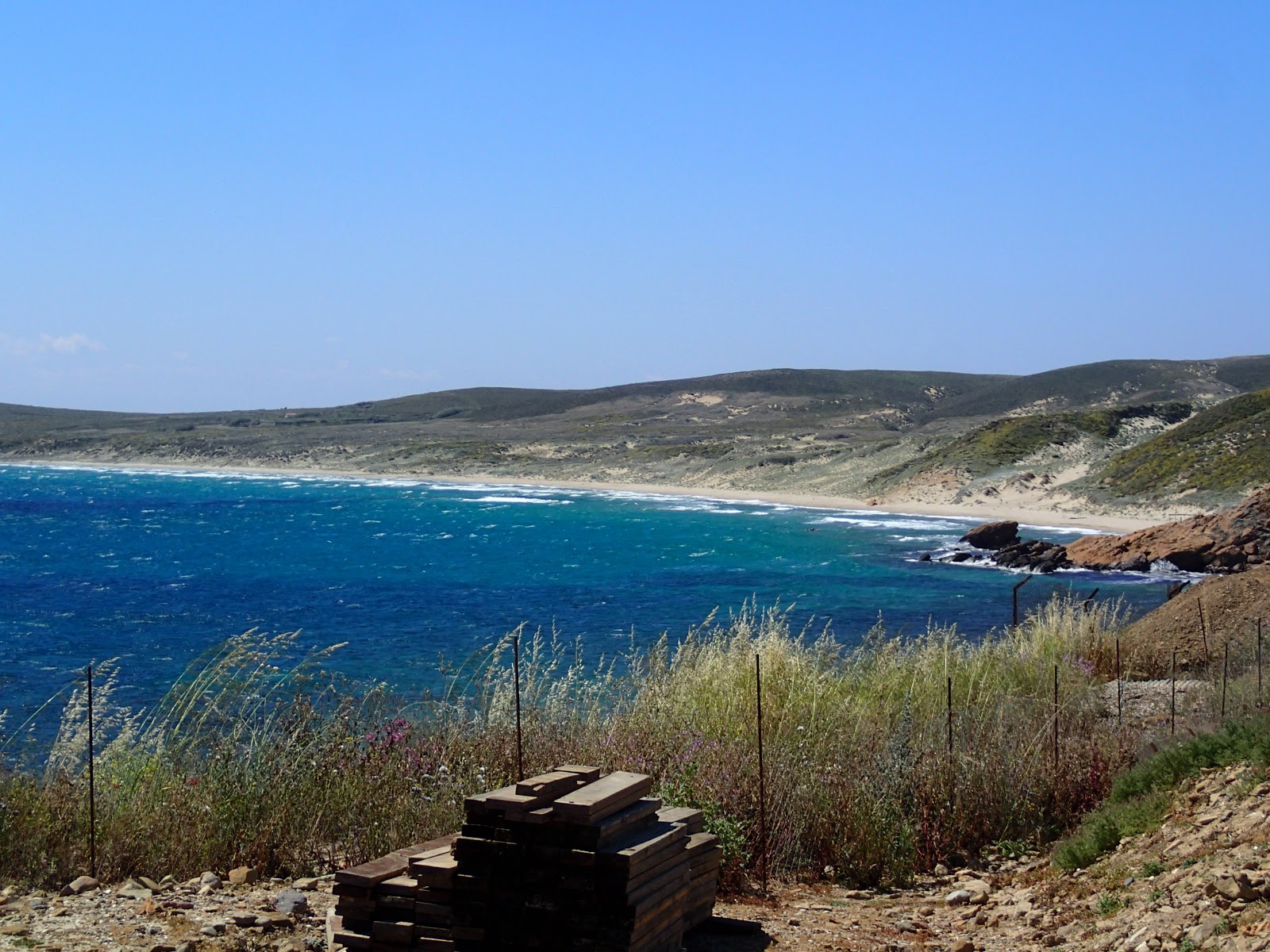
The remains were well preserved and well signposted, with a very informative little museum.
After Polichni we drove up to Kabireio, a sanctuary of the kabiroi, originally dating from around the seventh century BC with later additions, including a Roman sanctuary. 


There was not very much to see, though the setting was dramatic, on a clifftop with views over to Samothraki and layers of volcanic rock in contorted shapes. We then climbed down some steep steps to see the cave in which Philoctetes, the Trojan War hero, was abandoned by his comrades until his gangrenous leg healed. There was a sign forbidding us to go the cave, 

but the custodian told us that we could get into the cave by wading through the sea, but the water looked quite deep and was rough with waves rolling in.

The rock formations were very striking, with layers of contorted volcanic rock.

By now it was lunchtime and we were getting hungry. We found a café in the small town of Kondopouli, 

where we had a beer and club sandwich, before driving down a dirt track to Ifestia, the most important city on Limnos in classical times, the other side of the bay from Kabireio. Most of the city is unexcavated, but there are the remains of the theatre. 


As at the other sites, we were the only visitors, and this time there was not even a custodian there, although we spotted him walking over to the site with his dog. When he arrived we offered to pay, but he just said ‘no tickets’. We drove back to Myrina, passing the reputed volcano,

around the south coast, with views of Ag Evstratios and Mount Athos, getting back to the boat in time for tea.
Limnos is mountainous, with dramatic volcanic outcrops, on the western half and pretty flat on the eastern half, indented, with a lot of sandy beaches. In the east there were large wheat fields, quite a lot of cows, sheep and horses, and lovely wild flowers in the meadows and along the roadside. 


The roads were almost empty and we saw very few tourists or tourist facilities. There was an incomplete resort on the hill at Kabireio, which seemed a strange place to build a resort, and beach resorts on the west coast, but it is amazingly undeveloped for tourism, despite having an airport with the longest runway in the Aegean.
When we got back, two Russian charter boats arrived, having had a wet and windy passage from Halkidiki. In the evening, we went out to dinner with Paddy and Sally in an indifferent restaurant on the northern beach.
On Sunday morning, May 13th, we got up to be treated to a trumpet serenade from a ragged military squad who marched along the quay to their drums and stopped facing a closed up building opposite our mooring place (we later discovered that they were saluting not the closed-up building, but the raising and lowering of the flag on the castle above!). 

In the evening they marched with drums and trumpets from the end of the quay to the same place, singing as they went. We had a quiet day, in the morning walking over the headland to the south to look down on the next resort, then up to the church overlooking the harbor. In the afternoon we did odd jobs and cooked dinner aboard. Sally took our picture,

We got up at 6 on Monday, ready to sail to Samothraki. The deer from the castle had come down to the quay where they were eating the grass. A passing car frightened them off and they started walking back to the castle, when Simon managed to get a picture of them. 

We set off at 6.50 with a light south wind, motoring half the way and motor-sailing the other half. We arrived at Komariotissa, the port of Samorthraki, just before 1, but then had a problem deciding where to moor. In the end we decided to go stern-to the outer quay, but there was a crosswind of 12 knots, the quay was high and there was no one to take our lines. We dropped the anchor and ran back onto the quay, where Simon tried to get ashore. He got a foothold on a ring halfway up the quay, but there was nothing to hold onto on the top, so he fell into the water. Fortunately, there were steps a little way along, so he could get out, and Lin backed the boat in and threw Simon a line. The wind was too strong for Simon to pull the boat across, so he tied the line to a ring and Lin passed another long line, which she winched in once Simon had tied it off. So in the end we were safely berthed.


Paddy and Sally arrived from Limnos in Skylark at about 3.30. Soon after that the car hire man drove along the quay to offer us a hire car and promised to arrange for the fuel tanker to bring us diesel at 5.30. Needless to say, it did not come. Paddy and Sally came for a drink at 6.30 and the car hire man came back to tell us that the tanker could not come now, but he would get them to come at 8.30 in the morning. We went for a very good and very cheap dinner at a fish taverna on the quay.
On Tuesday, May 15th, we got a hire car with Paddy and Sally, with Paddy offering to drive. We drove first to the Sanctuary of the Great Gods, on the north coast. Sally had been told by some Italians that it was closed because of flooding, but they had managed to walk around the fence and find a way in. True enough, the path had been washed away by what had obviously been a torrent running down the mountain and there were two diggers at work repairing it. 

We walked across the debris and up the remains of the path to the museum which was ‘closed for renovation’, a traditional Greek euphemism. We then followed the path to the sanctuary, which was even more damaged than the path at the bottom, so we scrambled over the debris and got up to the entrance to find that it was indeed closed. We followed rough paths round most of the perimeter, but could not find any way in. However, we could see a lot of the site through the fence and the most attractive thing about it was the location.


After failing to get in to the Sanctuary or the museum, we drove up to the Hora, which is built up the sides of a gully on the side of a mountain. 


We parked in the centre of town and walked up to the medieval castle, which has been recently restored. 


By now we were getting hungry, but could not find a functioning taverna so we bought some pies in the baker, which we took to a bar, To Meltemi, with a terrace overlooking the village,with a great view down to the sea, where we ate them with bottles of the very good, though expensive, beer from the local micro-brewery. 
The bar owner had been born in Germany, where his parents had lived and worked for 35 years. He told us that much of the population of Samothraki had gone to work in Germany, mostly in Stuttgart, and many had now returned. He also told us that they had had a catastrophic storm last September, the run off from the mountains having destroyed the paths round the sanctuary and damaged many of the roads, as we were to see when we drove along the south of the island in the afternoon. He recommended the two best tavernas on the island, O Brakhos in Profitis Ilias for grills and To Akrogiali in Lakoma for fish, but by now we were full of pie and beer!

After lunch Paddy drove us through the narrow winding streets of Hora, over the pass and down to the south coast, which was amazingly green, with beautiful wild flowers. We drove up to Profitis Ilias, a mountain village, which had wonderful views along the coast, 


but O Brakhos did not look as though it was functioning. We drove back down a rugged windy to the coast road and turned east. The road went up and down over the hills, and in every gully the road was damaged, with masses of rocky debris around, and at one point a bridge had been destroyed, with the river temporarily filled with rubble and rough service on top.
We drove all the way along to the beach at Pachia Amos, a long sandy beach with a closed taverna, which was deserted. 


According to our old Rough Guide there is a hidden spring at the end of the beach. Simon set off to find it, but found nothing but a dried up gully. After a paddle and pushing the car out of the sand we drove back to the harbor, where we returned the car at about 4 o’clock. After drinks with Paddy and Sally we had bacon and eggs for dinner and an early night.
The outer quay was full by the evening, with most boats alongside. At about 7.30 a big Turkish catamaran came in and went alongside the inner quay. They left their servant washing the boat, while they went ashore. Sometime later they were told to move and went and anchored outside the harbor. Two large trawlers came in and went alongside where the catamaran had been, though they left early in the morning.
We got up early on Wednesday, May 16th, ready to leave at 7 for our return journey to Leros, with Limnos as our first stop. We said goodbye to Paddy and Sally, who were leaving for Thasos at the same time, and set off to sail into a stiff southerly wind.


Wednesday, 9 May 2018

Our northern tour - part one


Simon was very keen to start the summer with a northern tour, before the northerly winds set in, to visit islands we had never sailed to before, towards his project of visiting every inhabited Greek island. 

Thymaina

We left Arkhangelos at 7.40 on the morning of Thursday May 3rd in a light southeasterly wind, so we motorsailed 28 miles up past Lipsi, Arki and Fourni to arrive at lunchtime at the little island of Thymaina, between Fourni and Ikaria, where we anchored in the bay off the village. 

On the way up we didn’t see a single other yacht, but in the afternoon a German-flagged ketch came in and anchored in front of us.

After a bit of lunch, we went ashore to explore and walked up the hill to the church on the headland, 

which had very good all-round views.

 The village was very quiet and the majority of the houses were shut-up -  probably holiday homes of those who had left the island. 
There were a few men drinking in a couple of bars, but there was no taverna open and only a tiny shop. Another meal on board and an early night, ready for an early departure.

On Friday, May 4th, there was again little wind as we set off at 6.30 to motor-sail up to Chios. The previous day there had been quite a bit of swell, which had us rolling, but today the sea was flat. Again we met some dolphins, though these ones just gave us a couple of rolls and headed off. 

Karfas

At lunchtime we anchored off Karfas on Chios and rowed ashore to meet Costas and Lin, who had put up Majd, Manal, Luna and Dana in their house before the latter went to Athens to go to Germany. Costas and Lin had done a huge amount of work supporting the refugees, setting up and running a ‘people’s kitchen’ to feed the refugees and to give them something to do, preparing and cooking food. Costas video phoned Manal, who was so excited to see us all together.


Kardamyla

We rowed a long way back to the boat (the bay is shallow so we had anchored a long way out) and motored up to Kardamyla on the northeast coast of Chios, arriving at 5 having covered 65 miles. 


Statue on the quay dedicated by a shipowner's wife, Irene Tsakos

There was one other boat on the quay, a British couple in their yacht, who had arrived a bit before us. Kardamyla, although quite a big town, was even quieter than Thymaina, though the Port Police were active, coming to ask for our papers and charging us 6 euros harbor dues.
On Saturday morning, May 5th, the gas ran out as we were making coffee for breakfast and Simon could not connect the other cylinder because it had an idiosyncratic fitting and he did not want to strip the thread of the regulator, so we set off at 6.30 without any coffee. There was a bit of wind to start with, so we motorsailed for a while, but the wind soon went round and died, so we had to get the sails down. We had planned to go to Plomari, on the south coast of Lesbos, but then decided that it made more sense to go to Mytilene first, especially as we wanted to get gas, so we motored across to the southeast corner of Lesbos, then round the corner and up to Mytilene, logging 46 miles and arriving at 1.30. 

Mytilene

On the way in to Mytilene harbor we were summoned by the port police on the ferry quay, who quizzed us about where we had come from, obviously checking we were not people smugglers, and told us where to go in the old harbour and then to go to the Port Police. We went stern-to the harbour wall, the only yacht there, 

and went to have lunch in a little taverna in a back street. The food was OK, but the pigeons flying around were a distraction, especially when they shat on our table.
Mytilene old harbour

There was a big naval presence in Mytilene harbour, with the costguard boat, the tax police, two gunboats and Teresa May's contribution to patrolling Europe's borders, HMS Valiant


After lunch Simon went to the Port Police office only to be told that we did not need to go until we left – the port policewoman phoned the guy on the ferry quay and gave him a balling out. Simon then went off to find gas, ending up at the marina at the other end of town, where the receptionist called the gas man who brought the gas. While he was waiting Simon went and chatted to Paddy and Sally on Skylark, who had followed us up from Kardamyla. By the time Simon got back to Mia Hara the noise in town was horrendous – music blasting out from speakers in a disco on the quay – so we decided to go into the marina to get a bit of peace. The marina was half empty and the staff called us to go alongside, which entailed a rapid reorganization of fenders and lines.
We had come to Mytilene to meet Lin’s second cousin’s son Michael, who is working with the refugees in Lesbos Pikpa. We invited Michael to join us for dinner. He was not feeling well, but recommended a restaurant, Nan, which has been established by the women from Pikpa to provide a way of giving work to refugees and integrating them into the community. The food was wonderful, mostly middle eastern and Indian. On the way back the noise had got far worse as a large crowd blocked the harbor road, singing, chanting and letting off flares to celebrate the narrow victory of AEK in a football match. We were very relieved that we had moved to the marina!
The night was not entirely quiet, as we had the anticipated thunderstorm. We decided to stay another night in the marina and arranged to meet Michael for lunch in a nearby tavern on Sunday. Over lunch Michael told us about the organization of Pikpa, which sounds very impressive. It was set up by four women and now runs a centre for vulnerable refugees, just north of the airport, which has accommodation for about 100 people, living in a former children’s summer camp; a support centre, Mosaik, in Mytilene, which provides a wide range of classes, in English, Greek and Arabic, IT and Yoga, with a literary workshop and storytelling for children and adults, all for refugees and the local population, and has a bag workshop, where refugees make bags out of old lifejackets and bits of material; and the restaurant Nan, where we ate last night. Michael was not feeling well, but he offered to show us around Pikpa the next morning and told us how to get to Mosaik.
It was a grey and rainy day, so after lunch we went back to the boat to do odd jobs and have bacon and egg for supper, after our large lunch.
On Monday morning, May 7th, after doing some shopping, we walked into town to see Mosaik, which was very impressive. On the way we passed a large mosaic, on the wall of a building. The squares of the mosaic were made by refugees from many countries and by locals and put together as the 'magic carpet'.


In Mosaik were invited to come and see the bag workshop, where two men and a woman were hard at work sewing. 


There was a display of bags for sale, of which we bought several. We looked around the main building, where several classes were in full swing, with a lot of students, and saw the library. 


We then took a taxi to Pikpa, where we met Michael, who showed us round.
Pikpa is very choosy about who it takes money from and who it takes as volunteers. Volunteers have to work for a minimum of two months and to have relevant skills and experience. There are about fifteen volunteers at any one time, in addition to the permanent staff, who include two nurses and a psychologist. There was a range of buildings, the residents living in wooden cabins, of which they were building more. There was also a large kitchen, in which the refugees could cook their own meals, and a kitchen and dining area where meals were cooked for them several times a week. When we were there they were preparing food packs for distribution to the residents. There was also a very well stocked and organized clothes ‘shop’ where refugees could come to get clothes and shoes, a kindergarten for the young children, a vegetable garden and a forest school.


 Michael was obviously feeling unwell, so we did not stay too long. We then went down to the main road to catch the bus back, but hailed a taxi, which turned out to be the same one that had brought us there!

Plomari

We left the marina at 11.30 and motorsailed, then motored, to Plomari, on the south of Lesbos. On the way we passed a fishing boat, hauling its nets.

In Plomari we moored on the quay in the harbor. 

There were two other yachts already there, so we went between them, because we were not sure of the depths, and later a Gibraltar-registered Russian skippered charter arrived. 


Plomari was once an industrial town, with a soap-making factory, a factory making brikettes from olive stones.and many others, nearly all of which are now derelict.


Plomari is where Lin’s favourite ouzo, Barbayanni, is made, so we walked a mile or so along the coast road to their museum and factory tour, which was very interesting. Barbayanni is still owned and run by three brothers, the sixth generation of the family, and is the longest established ouzo factory in Greece. The guy who showed us round explained that their ouzo is 100% triple distilled and made to the highest standards, not topped up with industrial alcohol, like the cheaper competitors. In addition to aniseed they use a secret recipe of local herbs to give their ouzo its distinctive taste. We sampled the ouzo, of course, and bought a bottle of their strongest ouzo, Aphrodite, 48% alcohol, which was delicious.


We walked back to the harbor, showered, and went out to dinner at a local taverna. The one we had planned to go to, top of Trip Advisor’s list, was not open, but the one we did go to was friendly and the food was quite good.

Sigri

We left Plomari at 7.30 

to motor round to Sigri, at the southwest corner of Lesbos. At first there was no wind, but later it got up to ten knots on the nose, so we kept motoring. We got to Sigri about midday and anchored in the bay south of the town. 


The harbor is being reconstructed and a naval ship docked on the quay soon after we arrived.

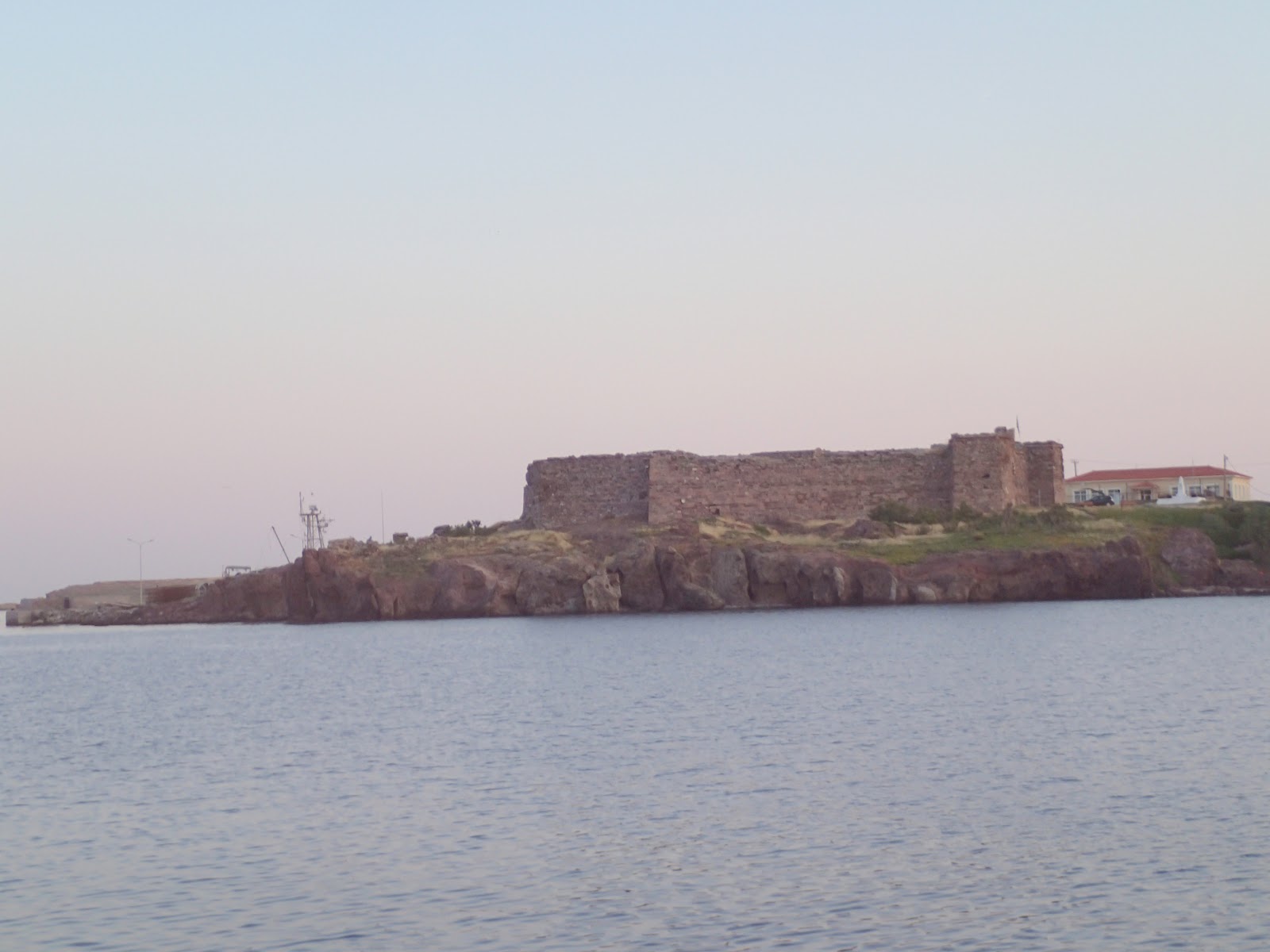
Sigri is a quiet town with a Turkish castle 


There was a large mansion in the centre of town, which was some sort of (ecclesiastical?) museum, but was closed up.

We visited the wonderful geological museum, featuring the petrified forest of Lesbos, but covering much more than that. 
The garden was full of butterflies.

When we got back from the museum we had a swim, which was not too cold, and cooked dinner aboard. Late in the afternoon a Swiss yacht arrived and anchored in the bay, the only other yacht we had seen since leaving Plomari.

Agios Evstratios

We left Sigri at 6.30 on Wednesday 9th May with a moderate southerly wind and motorsailed to Agios Evstratios on a clear sunny day, arriving at 1pm after a quick 47 miles. 

Agios Evstratios was a prison island under Metaxas and then under the Junta, the most famous prisoner being Mikos Theodorakis. It was destroyed by an earthquake in 1968 and rebuilt. In 2009 it was declared that by the following year Ag. Evstratios would be a ‘green island’, powered entirely by renewable energy and using only bicycles and electric cars for transport. We didn’t see a single bicycle, electric car, solar plant or wind farm, or any recycling bins, though we did see some wind vanes lying on the ground by the cemetery. But this is Greece!

We tied up behind an Amel 54 alongside the big new harbour wall 

and walked into the little town for lunch, having delicious oven-cooked lamb and potatoes with peas and tomato salad. 


We then walked up the hill to the cemetery, which had a good view over the town, rebuilt after the earthquake.

On the way up, we passed the Museum of Democracy, which was completely shut up, then went back down and round to the beach and back to the boat. It is a pleasant little town with few tourists and, it seems, not many visiting yachts.
Soon after we got back to the boat two men arrived from the Port Police and told us that we had to move because a very large ship was coming in at 4 in the morning. They told us we should go inside the entrance to the fishing boat harbour, assuring us that there was enough depth and offering to help us, which we accepted because it would be tricky getting on to the quay with a Force 4 wind  blowing off it and little room to maneuver in the harbor entrance. We cast off and motored round to the fishing harbor, intending to turn in the harbour entrance and tie up along the starboard side. However, we ran aground on the approach to the harbor entrance, so there was no room to turn and we had to reverse onto the quay, which was tricky with the wind blowing the bows off and little steerage in reverse. Fortunately, the port policemen took our lines and hauled us in and we managed to tie up without hitting anything. The French Amel 54 decided that they did not want to risk the manouevre and so would leave before 4 in the morning.


An early summer


We flew out to Athens from London on Tuesday 24th April and stayed the night with Lena. On Wednesday afternoon we took a taxi to Piraeus and boarded the Superfast ferry to Leros. We had booked a luxury cabin, which was still cheaper than flying, 

and celebrated by having a very good dinner in the a la carte restaurant.
We arrived in Lakki at 4.30 am on Thursday. Costas had left us a car on the ferry quay, so after a coffee in the café to let the lorries leave, we drove up to Partheni and parked outside the gate until the first workers arrived at 6.30 and we could go in and board Mia Hara. Everything seemed to be in pretty good condition – less dust than usual outside and the salt that we leave to combat the damp had absorbed very little water – they had had a pretty dry winter. After a bit of unpacking, we drove into Lakki for shopping, to get our new DEKPA (the Greek cruising permit), to see our friends and for a beer and lunch at Poppy’s before coming back to start work on the boat. When we got back we finished unpacking, Simon washed the outside of the boat while Lin started to clean and polish inside. For dinner we had an excellent takeaway from Marietta. When we came to light the oven, we found that the cooker, which had been repaired, had been returned without the oven shelf. Next morning Simon went to ask Tony about the shelf, he phoned Thomas, who had repaired the cooker but had now left the yard, who knew nothing about it, but it was soon found lying around in the workshop.
From Friday to Monday we worked on the boat, mostly sorting things out, cleaning and polishing inside and out and fitting the sails, bimini and storm hood. This year, fortunately, there were very few repairs. On Saturday night we went to Pandeli to have dinner on the beach with Al and Kitty, on Sunday we went for dinner at Milos with Frank and Lin, and on Monday we met Julie and Jad and went for dinner with them in Alinda. We apologized to Julie that we would miss the launch of her book (Hitler’s Island War: The Men WhoFought for Leros) on May 10th, but it looks as though a lot of people will be there. On Monday we did a major shop, because Tuesday was bank holiday so all the shops were closed.
On Monday evening Simon committed a serious blunder and, not for the first time, left the shower gel in the shower. Lin was not pleased. When Simon went back the shower gel had gone, so he put a post-it on the door asking whoever had taken it please to return it as Simon’s life was at stake. Next day it reappeared in the shower, so Simon’s life was saved.
Rumours have been flying around, spread by their competitors, that Agmar is bankrupt. It obviously is not bankrupt at the moment, but it is clear that its financial difficulties have increased and there is a danger that it will close as a result of a long-drawn-out court case which is due to come to court in November. We decided that we could not risk the boat being trapped in a bankrupt boatyard so have taken a contract with Evros, the other marina in Lakki, from July. On Monday Irene called Simon in to the office for long lecture about the falsity of the rumours, that Agmar was clearly not bankrupt as it was still operating, and that they had great plans for the future. Simon told her that we did not believe the rumours, but it was obvious that they were in great difficulty and we felt that we could not take the risk of renewing the contract. Irene did not persist and did not seem in the least surprised by our decision.
On Tuesday we finished the jobs on the boat to be ready for launching on Wednesday morning, 2nd May, allowing ourselves time to go into town, say goodbye to Anna and Poppy and to go and see Galya in Pikpa. Galya was very pleased that she has now got her asylum and is off to Athens for a month to sort out her papers before coming back to Lakki.
We launched without any problems in the middle of the morning on Wednesday. Our plan was to head north before the northerly winds set in and the forecast looked good. After launching we motored across to anchor off Arkhangelos, followed by a family of two large and two small dolphins, who played around the boat. When we arrived we rowed over to Stigma for a lunchtime beer. Evropi was there alone – Georgos had gone to the mainland to meet Tasos to deal with a problem with his water boat, which had been drive ashore by a winter gale. The taverna and jetty had suffered a lot of damage in the strong winter southerly winds so Georgos had had a major job remaking the roof of the terrace, repainting, and rebuilding the jetties.

We had our first swims of the year in the afternoon. 

Usually it is too cold to swim until late May, but a week of hot sunny weather had warmed the water up to 21 degrees and swimming was lovely. Georgos came back in the afternoon and we rowed ashore for dinner with them before getting an early night, ready to leave early next morning.